
All emancipation is a reduction of the human world, of relationships, to the human being itself.
— Karl Marx, MECW1
We begin our exploration of Caretaker Tech’s digital economic structures by introducing key terms, framed within a narrative of how the economy transforms the material world. (2.1). Within Caretaker Tech, a process cannot be started without a request for something. The process of publishing requests itself will be explored in the second section (2.2). For planning, especially the distributed kind, it is necessary to capture knowledge on economic processes as recipes. The third section covers the origin of recipes, the definition of abilities through recipes and the recipes scope (2.3). A first glimpse into plans and how they distinguish from scenarios follows as preparation for the more complex next chapter (2.4).
Transformative Steps#
A heater gets repaired, a house gets built, a room gets cleaned, a stomach gets filled. With each of these processes, the world is a little different than it was before. There was someone who had an intent to have something done. Then they published it; they made themselves heard.
Something was needed so the intent could be satisfied by someone’s work: an input like the broken heater, tools for repairing it, and spare parts. Those economic resources flowed into the process and, at least most of them, flowed out of it again: the outputs of the process. The tools were just used; they leave the process as they entered. The heater was modified: it changed through the process, it is no longer broken. And the spare parts, they were consumed by the process. They disappeared, but something else appeared: some electronic rubbish as a side-effect. It is always an economic event, when something enters or leaves a process.
Who makes those resources flow, who executes those processes? We call them agents: anyone who acts under their own power or authority. It may be a person, an organization (like a community or a company), or even some non-human nature with agency: an ecological agent. Without agents, there is no economy, no work, no motion. They direct the ever-ongoing transformation of the world.
Publishing Intents#
Agents will be able to publish intents and propose their satisfaction to single persons, specific groups or publicly. Agents will be able to specify and restrict scenarios of satisfying those intents (according the related governance situation). Agents will be able to agree or disagree with proposed scenarios to satisfy their intents. Agents will be able to mark published intents as satisfied or withdraw the proposal.
Caretaker Tech is a digital sphere to support commoning, it will not model every commoning structure. Consequently, even though Caretaker Tech is above all concerned with satisfying needs, not every plan within it will be initiated by a need. Needs will, naturally, also be communicated outside of Caretaker Tech. A agent who knows of a need and has an idea of how to satisfy it, however, can use Caretaker Tech to publish any intent on which satisfying that need depends.
To be less cryptic, consider an example: Alice tells Bob that she is cold, and Bob knows that Alice’s heater is broken. Through Caretaker Tech, Bob has several options of intents he may publish in this situation. He could ask for the repair of the heater, which is the most straightforward way to help Alice. The problem is that the chance of this being done may not be very high, since it depends (a) on someone with the corresponding abilities voluntarily committing to do it and (b) on the necessary spare parts for the heater being available. Another option would be for Bob to publish an intent for another heater, simultaneously with the intent to repair the one of Alice. There is, moreover, more than one way to make such a heater available: someone might have one they do not need; another heater might have been broken for some time but be easier to fix; or someone might be able to build a heater that, while not of industrial standard, is better than nothing. Since Alice’s need is not a working heater — that is only one strategy to satisfy it — but rather not to be cold, Bob could also, in consultation with Alice, publish that need alone, as Alice might be open to other ideas. Depending on her situation, a warm jacket or blanket would also help, at least in the short term. Keeping an open mind is a considerable advantage in structures built on voluntariness and a limited pool of shared resources.
The more specific a published intent is, the greater the chance that it will not be satisfied. Conversely, the closer a published intent stays to the underlying need, the more ways it can be satisfied. If the need itself is not to be published, but several paths toward satisfying it are to be opened, then the relationships among the intents must be defined. Fixing the heater, making another heater available, and making a jacket or a blanket available amount to four distinct intents, yet they are related: if the heater is repaired, then neither the other heater nor the jacket or a blanket will be needed anymore. If a jacket is made available for Alice, the heater still needs to be fixed, or another heater is still needed. If another heater is made available, the jacket or blanket is no longer necessary, but Alice’s current heater could still be fixed, but the priority for that decreased.
Once an intent has been published, there are three main ways to gather processes capable of satisfying it:
The publisher of the intent defines concrete processes that will, in their opinion, satisfy it.
Software algorithms propose possible processes for satisfying the intent, which can likewise be accepted or declined. These proposals can be oriented toward locally available resources or toward existing local structures, and they may be constrained by criteria set by the publisher.
Other agents propose to the publisher ideas about how the intent might be satisfied, based on their own experience. Like algorithmic proposals, these can be accepted or declined.
Furthermore, Caretaker Tech will let agents make a published intent publicly or restrict it to specific persons or groups, such as friends or family. In either case, the intent can be made without revealing the receiver’s identity to anyone. Agents can also specify whether the intent is recurring. And once a intent has been satisfied, it must be possible to mark it as such, just as it must be possible to withdraw the proposal, for example, when the need has been satisfied through other structures.
In publishing a need, the person who requested its satisfaction naturally holds the governance to define which processes are appropriate for it; in other cases, this depends greatly on the circumstances. Consider again Alice’s heater, which needs to be fixed: we assumed that it is her private property, in which case Alice may agree to any repair proposed to her. But it may not be her private property. The heater might belong to her landlord, who may not want just anyone fixing it in whatever way. In that case, Bob’s publishing on Caretaker Tech of an intent to fix it would not be legitimate — Alice would first have to ask the landlord. The heater might also be a shared resource of the housing cooperative in which Alice lives, in which case others would also have a say in how it is repaired. And someone might rightly insist that it be repaired by a professional, since poor repairs could cause a fire. Before publishing the intent to fix it, Alice and Bob may therefore need to raise the topic at the weekly meeting or follow whatever policies — implicit or explicit — the housing cooperative has set.
But there is no cause for concern: questions about regulation — or about dealing with (resource) regulations in general — lie outside the scope of this chapter and the next. We will take them up in chapter four, Handling the Commons.
Recipes#
Agents will be able to create recipes and make them publicly accessible. Agents can specify resources needed to its performing, describe the process of transforming those resources into the desired output including its average duration. Agents can further classify the recipes according given categories or tags. Agents will collect their own recipes and those of others in a personal library. In the library agents can mark recipes as abilities or rate them according their own liking to perform them. Recipes could be grouped into recipes of higher complexity.
Most of us think of recipes exclusively when we are hungry. We look up recipes and each of them is an idea of how hunger can be satisfied, depending on the available ingredients and the cook’s abilities and time. Each recipe is a container of one or more recipe processes: the single steps of preparing the dish like cutting vegetables or cooking noodles. While the term recipe is deeply associated with cooking, its concept is more general: a recipe could also describe how a hut is built out of wood, screws and woodworking tools. Or how a room could be cleaned with a vacuum, a bucket, some detergent and a cloth. If an agent has access to economic resources (the real, material things) and those resources conform to the specified resources of the recipe, that agent can — according to their abilities — perform the process described in it.
As in Caretaker Tech recipes will be the building blocks of planning, we will explore them a little deeper. From here on until the fourth chapter, not a contemporary example is used, but recourse is made to the production of a resource that Marx used in his value form analysis of Capital: the 20 yards of linen [@mecw35 p. 58]. To go back to the childhood of capitalism and take this unmodern example has the advantage that the production process was more vivid at that time. Also, while building modern structures of commoning will build on more modern tools, the complexity of those structures will need decades to unfold.
Principle and Origin#
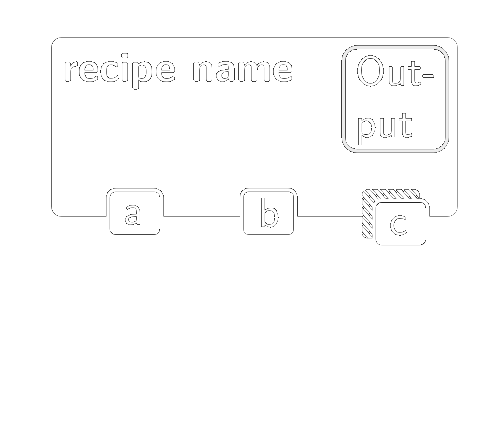
A recipe is an individual experience that is formally shared and thus made available to others. In this way, its origin can also be understood: Bob publishes, for instance, the request for linen fabric, and Carol knows how to manufactor it. Carol, if everything she needs for the process is available to her, commits to satisfy the intent and finally performs the process to the best of her knowledge. If Bob is satisfied with the result, the commitment is fulfilled. Carol describes what she has done, what kind of resources were necessary for each step (the recipe flow inputs) and what kinds of resources were there after its performance (the recipe flow outputs). Finally, she publishes a single recipe with a generic name that includes all necessary steps for its performance.
In Caretaker Tech, recipes will unfold their potential only when two conditions are met. First, the recipes must be stored in databases that Caretaker Tech can read and understand. Second, databases describing available economic resources must also be accessible to Caretaker Tech â specifically, databases that record which resources are locally available and under what conditions. When both conditions are satisfied, Caretaker Tech can generate efficient step-by-step scenarios for satisfying any intent in light of the local circumstances, and propose them to agents. This method is called the Distributed Planning Process and is introduced in Chapter 3. Chapter 4 introduces methods for setting machine-readable rules about resources in collective governance situations.
In addition to the inputs, outputs and process description, each recipe may contain additional attributes. This may include, for instance, the effort quantity expected for its performance, which can be measured in various possible units, while working time seems to be the most practical (see section 3.1.2 The Unit of the Distributed Planning Process). It may also include the number of persons that are at least necessary to perform the process. The recipe may be classified with qualitative attributes like “dirty” or “entertaining” and also with qualifications that are necessary to perform it. Caretaker Tech will offer collective action methods to adjust the attributes of recipes according to the agents real-life experience using them.
A recipe may come in various forms such as text, audio or video. A prominent existing recipe database is wikihow, but any descriptive video on a streaming platform can be a recipe if it is somehow framed with its in- and outputs, that Caretaker Tech can work with it.
Library and Abilities#

Within Caretaker Tech, agents will have a library of recipes. Recipes can be manually added to it, or the recipe is automatically transferred to the library after the person has executed the corresponding process at least once. In the library, agents can mark recipes (with the corresponding recipe processes) according to whether they execute the process out of desire, out of necessity, or anything in between. Depending on this, the agent will be notified by Caretaker Tech as soon as a process is proposed in their local area, or the person is only notified, if at all, when a process has a high personally defined urgency (see 5.1.8 Data Interpretation and Sense of Fairness).
Caretaker Tech will further give the option to mark recipe processes in the library as an [ability]{acronym-label=“ability” acronym-form=“singular+short”}. An ability is the agent’s self-proclaimed intrinsic knowledge of how to execute the specific process. Marking recipe processes as abilities gives agents the option to simplify plans through their commitment to recipes of higher complexity. As abilities are self-defined, they differ from qualifications. Qualifications need to be certified by authorized persons or institutions and may be used as a boundary to committing to a process or using a resource.
Scope of Recipes#
Looking closer at recipes, they are just a container for one or more recipe processes. Those recipe processes are the single steps of the recipe, all with their own inputs and outputs. The scope of recipes processes can vary considerably. For instance, let’s see how linen fabric gets manufactured using a loom, a warping board, some linen yarn and a plain weave binding pattern: For the linen yarn to be processed in the loom, the threads of the yarn must first have the same length and the correct order. For this, it is stretched on the warping board. The linen yarn prepared in this way is finally called the warp. This warp must be stretched on the previously unwarped loom. In the weaving process, the vertically running threads of the fabric will emerge from this warp. Another linen yarn is finally stitched through the heddles and reeds of the warped loom according to a plain weave binding pattern. The plain weave binding pattern specifies how the threads must run through the loom so that the desired fabric pattern emerges at the end. Through the thereby completely stitched loom, the linen fabric can be produced.
This whole process could be described as a single recipe process. But as it involves multiple steps, the processes could also be separated into two: first the stretching of warp on the loom and after that the manufacturing of linen fabric (this time with an already warped loom as input). Naturally, we can zoom in even closer and extract the manufacturing of a warp (#A) recipe process out of stretching warp on loom (#B) and extract the recipe process stitching of the loom (#C) out of manufacturing linen fabric (#D), which in this case has only the stitched loom as input. See figure 2.3 for reference.
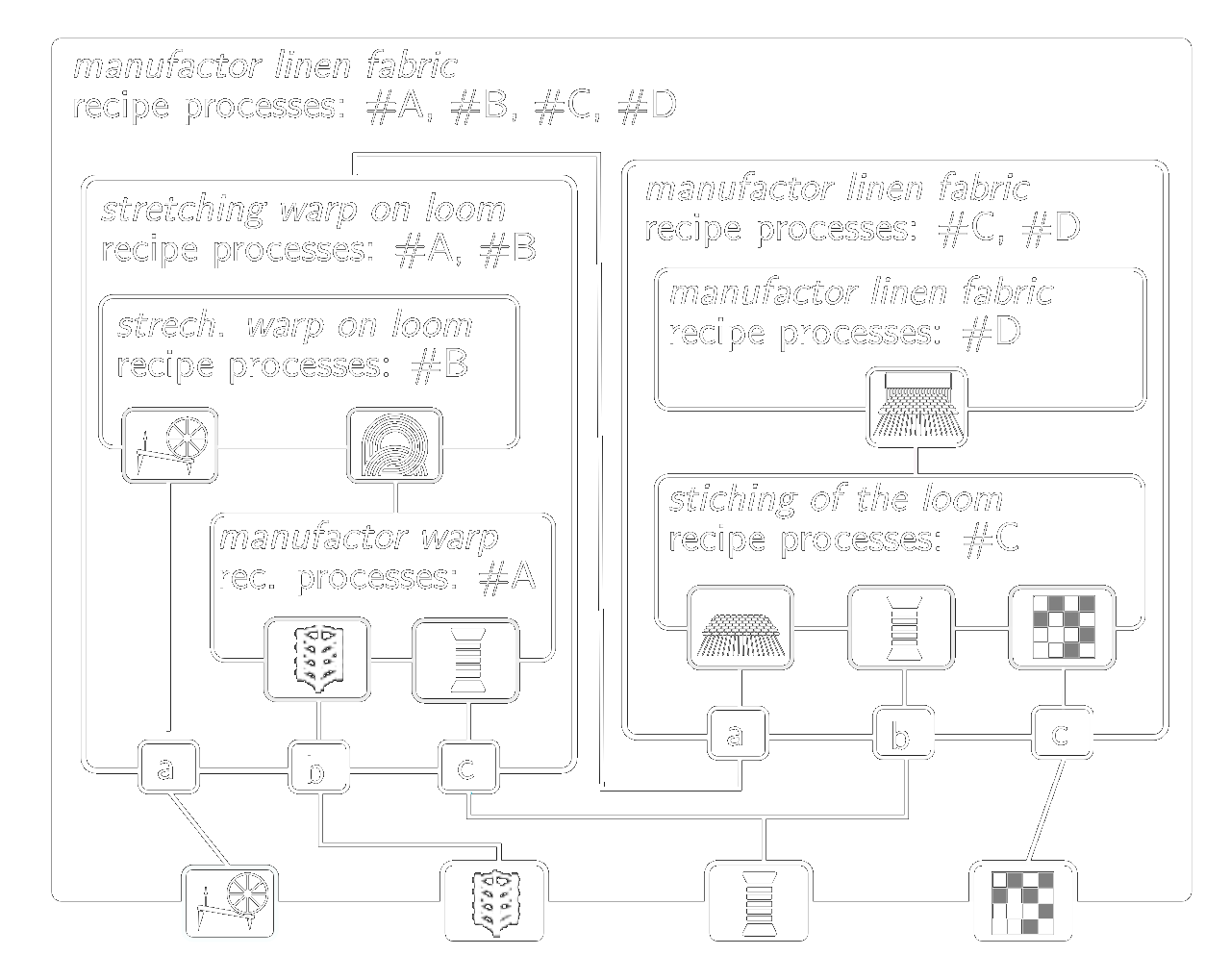
For the production of the linen fabric itself (including the effort necessary to accomplish it), it does not matter if the recipe contains one, two, four or even more recipe processes. But it does make a difference for the agent if they have to commit to a recipe containing four steps or just one. Marking recipe processes as abilities in one’s personal library (2.3.2) simplifies the act of commitment. For instance, Alice has done recipe processes #A and #B before and marked them as her abilities. For the recipe processes #C and #D she has the corresponding qualifications, but she hasn’t performed them alone yet and is unsure if she can do it. If the resource linen fabric is publicly required in her local area, three recipes will be proposed to her: one recipe including only recipe process #D, on recipe including only recipe process #C and one recipe including recipe processes #A and #B, as they are both abilities of her. If she gains experience in performing #C and #D and marks them as abilities too, only one recipe will be proposed to her the next time it seems sensible to manufacture linen fabric with a loom from the 18th century. As the recipe is nothing more than a collection of one or more recipe processes, they can be automatically generated for the agents, always leaving open the option to commit to only one of the included recipe processes.
Working with smaller recipe processes instead of larger ones could be useful to increase efficiency. In fact, it is one of the three ways in the capitalist mode of production to divide workflows into smaller parts, with a single agent associated with each, working on it continuously (see section 3.5). While such a kind of cooperation might not appeal to everyone, it does to some — especially in times of scarcity, where efficiency may be a high priority.
Scenario and Plan#
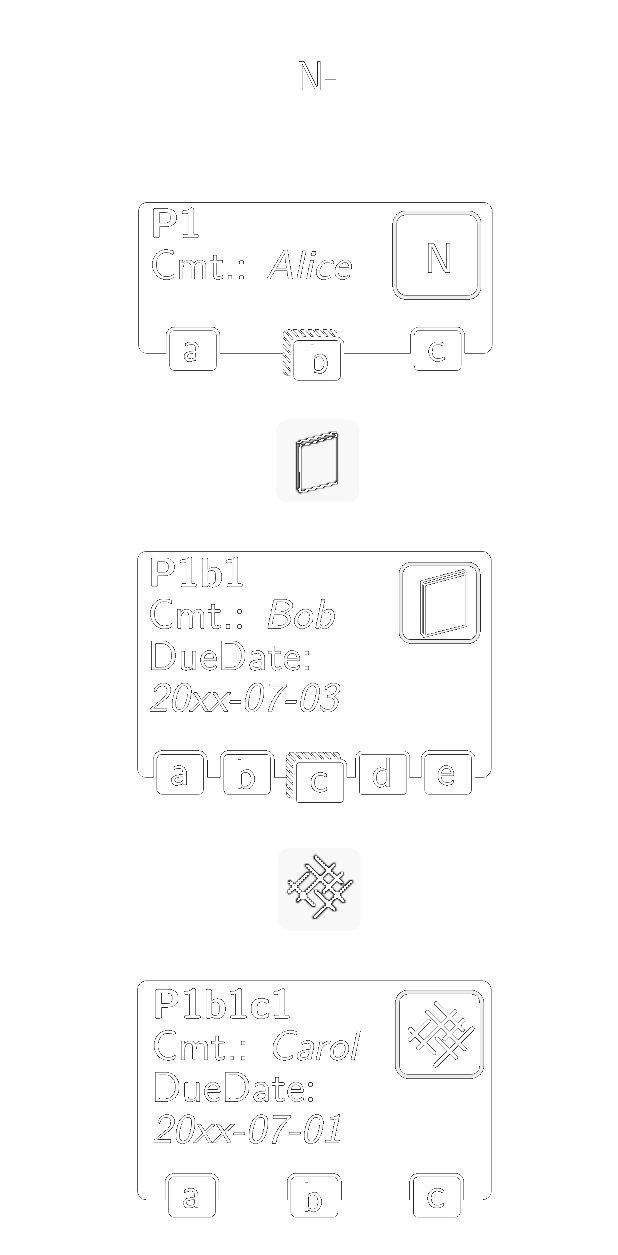
Plans are a collection of processes aiming to satisfy one or more intents. They include the intent(s), the identifiers of agents committed to performing those processes, the shared resources scheduled for the processes’ performance, and additional information like due dates for the single steps. The processes in a plan are connected through resource specifications: a resource which is the output of one process needs to be the input of another process. In the special case, when the same identified resources needs to go through multiple processes, not the resource itself, but its stage (like tested or untested) connect the two processes. As recipe processes have all their inputs and outputs defined, they make planning easier by being machine readable, but plans can also include processes that are not specified as recipes.
Every plan inside Caretaker Tech will start with a published intent, followed by the process of satisfying it. In figure 2.4 the request aims to satisfy a need for artistic expression (N-). The agent, Alice, who published the intent and preselected the process of painting for its satisfaction, committed — naturally — to performing it (P1). For its performance, three economic resources are required: a paintbrush (R1a), a canvas (R1b), and paint (R1c). The paintbrush and paint are available to her, but not the canvas. In this plan, Bob committed to performing some process (P1b1) until July 3 to make the canvas available for Alice, but he depends on Carol to make linen canvas available for him until July 1. Carol, who committed to Process P1b1c1, has everything she needs to perform the process and therefore no further processes are necessary.
A plan with all the processes, commitments, etc. is the final result of a planning process. Before such a plan is settled, it is one of many scenarios. A scenario is an idea of how an intent could be satisfied. Suppose there is the intent to cover the requirement for the canvas and an agent intents (they haven’t committed to it yet) to produce it (see figure 2.5). This “production of a canvas” has already been described as a recipe process, which has the following five inputs: (a) a hammer, (b) nails, (c) linen fabric, (d) stretcher frame, and (e) a stretching device.1 The agent who intents to perform the process has the resources “hammer”, “nails”, and “stretching device” available, while “linen fabric” and a “stretcher frame” are not available to them. Furthermore, this agent has no personal contacts and is not part of other structures through which they could obtain these missing resources. They therefore publish an intent for making linen fabric available through Caretaker Tech.
As further shown in figure 2.5, there are different scenarios for how those resources could be made available: The linen fabric could, for example, become available via a transport of existing linen fabric or the production of the same. The transport could have the required inputs of (a) linen fabric, (b) vehicle, and (c) fuel, and the production of linen fabric could entail the requirements (a) unwarped loom, (b) warping board, (c) linen yarn, and (d) plain weave binding pattern.
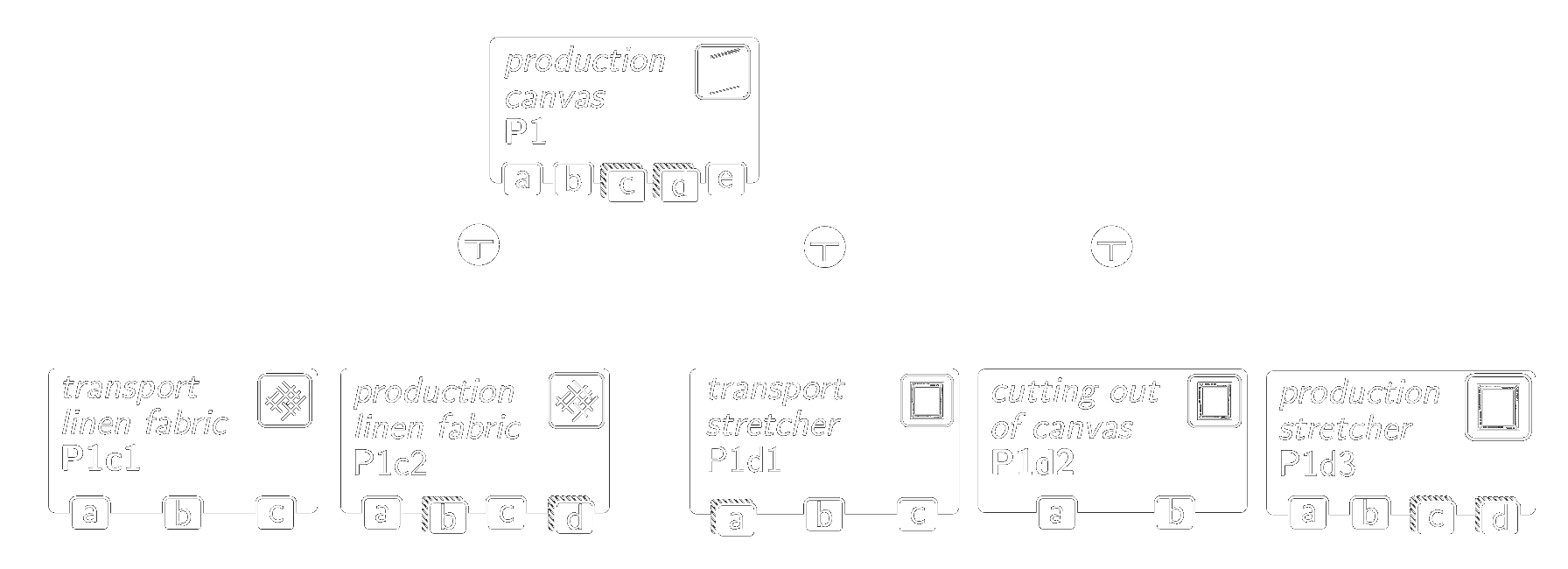
Three different scenarios for making the stretcher frame available could be the process of transport, the cutting out of stretcher frame from an old canvas, or the new production thereof. The various requirements — which in case of non-availability would also entail corresponding processes — could be: (a) stretcher frame, (b) vehicle, and (c) fuel for the change of location; (a) used canvas and (b) knife for cutting out from an existing canvas; (a) miter saw, (b) wood strips, (c) nails, and (d) workbench for the production.
Is a plan settled when for every process required to satisfy a published intent agents are found and everything needed is available to them? Not necessarily. Imagine nowadays linen fabric is needed and someone really intents to fulfill it with a 200-year-old loom. This could be okay for everyone involved, but it definitely isn’t from a perspective of efficiency. And efficiency (for satisfying needs, not for producing a lot of stuff) is the main thing needed for commoning to leave its niche and compete with capitalism. So, how are efficient plans created while staying with the method of self-chosen commitment to proposed processes? The answer lies in the order of such proposals and will be treated in detail in the next chapter: The Planning Process.
A necessary resource for most processes is an suitable room. To not constantly list this anew and thus hinder the reading flow, this is abstracted from in the entire text series. An exception is the chapter 3.2 Factors of Total Effort ↩︎