
Humanity has passed through a long history of one-sidedness and of a social condition that has always contained the potential of destruction, despite its creative achievements in technology. The great project of our time must be to open the other eye: to see all-sidedly and wholly, to heal and transcend the cleavage between humanity and nature that came with early wisdom.
— Murray Bookchin, The Ecology of Freedom
Caretaker Tech is the digital sphere of an economic infrastructure that will, one day, support a modern way of life beyond market and state. This digital sphere will support complex sharing situations and building complex cooperation structures of volunteers, directed by the participants’ values and needs. Caretaker Tech and its context will be introduced in the first section (1.1). Throughout the conception, the Structural Formula of Commoning serves as a common thread and helps to grasp complex economic structures aimed at the satisfaction of needs (1.2). A Glimpse Into the Infrastructure presents both essential aspects of Caretaker Tech and the structure of the text that follows (1.3). Since compatibility is of the highest value in any open system, Used Vocabularies (Valueflows & ODRL) explains the reasons for the vocabularies used.
Introduction#
Although software is described throughout this book, this text is no more about software than the subject of money is about metal and printed paper. The book is about fostering an open digital infrastructure that expands the non-capitalist sphere and thereby revives practices of solidarity. Before this infrastructure is framed further, it will be situated within the movement of commoning, in relation to the capitalist mode of production, and as part of the history of the caring society.
On the Two Streams of Society#
Of all the stories that connect the struggles of our ancestors with our own, the one told by the Kurds is especially beautiful. In it, there are two kinds of society: the caring society and the patriarchal-hierarchical one. For hundreds of thousands of years before the second arose, we wandered the earth as clans. Back then, we could imagine neither a life outside the clan nor any privileged place within it. Because we did everything for our common survival, sharing was as natural to us as contributing the work of our muscles and minds to our clan’s survival. At the heart of each clan stood the mother-women, and when we began to settle around 10,000 years B.C.E., a polycentric religious belief system grew up around us, with the mother-goddess Inanna — the strongest of them, the one who opened the women’s wombs in labor — as its most worshipped figure. The Neolithic period in Mesopotamia lasted a few thousand years, and its final decades overflowed with innovation and prosperity. Later, when this era was already gone, it was remembered as paradise in the collective memory.
There is a recurring theme in human history: people invent new methods to make life easier, but what they actually end up changing is society itself. Through these innovations, a single person could produce more than they could consume: a surplus product emerged, and with it the beginning of one group living off the work of others. In the cities, a complex system of levies and property took shape, justified by priests in administrative positions. The surplus fed a newly created class of soldiers, who protected the cities’ property and enlarged it by slaughtering their neighbors. Around that time, in the second millennium B.C.E., the Babylonian creation myth Enuma Elish was written; it calls the mother-goddess a witch who must be torn into a thousand pieces. As women were pushed further and further out of society, the figure of the god-king emerged: political power and religious justification embodied in a single man. This was the beginning of the patriarchal-hierarchical society, whose rule has continued ever since, in ever-changing forms, through the steady accumulation of power.
The kurds say, that despite all this oppression, the caring society never died. We lived in clans for hundreds of thousands of years, and their values of freedom and equality are engraved deep within us. Wherever there is oppression, there is resistance to it, carried by the memory of how things once were. It is the caring society that rises up when peasants revolt against aristocrats and workers unite against capitalists. It is the caring society that speaks when feminists roar against the roles forced upon them and when ecological activists fight for the rights of nature.
It is in these struggles that Caretaker Tech will take its place. In times of capitalist property, it will help us share what we have. In times of impenetrable complexity, it will help us act on our values. And it will help us care for one another — with our muscles and with our minds — living in the spirit of freedom and equality.
On Capitalism#
Of all the formations of the patriarchal-hierarchical society, capitalism is a rather special one. When the French beheaded their kings and priests, did they have any idea what they were awakening? One wonders whether they would have done it, had they known. To live and rise, Capital needed not only people free of the means to survive on their own, but also free from personal domination. Under these conditions, power concentrated faster than ever before, but the manner in which it operated changed fundamentally. The capitalist regime is a subtle one, enforcing the oppression of the working class silently. And this, too, is new: it is like a motor that can never stand still. Independently of the will of any ruling class, it deepens a structure of never-ending work and constant destruction of nature.
Yet capital seems quite innocent at first. It is nothing more than the movement from a given amount of money toward a larger sum of money, with the buying and selling of commodities in between. Marx described it as follows [@mecw35 p. 158]:
$$\mathsf{M \enspace - \enspace C \enspace - \enspace M' }$$Someone takes an amount of money (M), buys a commodity (C) with it, and then sells it for a higher amount of money (M’). But why would anyone pay more for something than it was bought for in the first place? Perhaps the buyer did not know the original price, or simply lacked the time and the contacts to buy it more cheaply themselves. This kind of capital is called trade capital. Yet there is another, often sturdier way of making money out of money: production capital. Its formula [@mecw36 p. 57] may look a little overwhelming at first glance, but if you take your time with it, it will genuinely help you understand capitalism better. Since Caretaker Tech is very much about structure, you can also regard it as preparation for the chapters that follow.
$$\mathsf{M{\enspace - \enspace}C{\enspace < \enspace}\begin{matrix} \scriptstyle\mathsf{L} \\ \scriptstyle\mathsf{MP} \\ \end{matrix}{\enspace - \enspace}\ldots P\ldots{\enspace - \enspace}C' \enspace {\scriptstyle (C\,+c)}{\enspace - M}'{\enspace {\scriptstyle (M\,+m)} }}$$Someone (“the capitalist”) starts with some money (M) and uses it to buy commodities (C) from the market: on the one hand means of production (machines, computers, any kind of material, for example) and on the other labor power — and if you work for a paycheck, that is you behind it. The paid people then work on those machines / computers / etc. and produce (…P…) a commodity (C’) whose value amounts to the cost of the capitalist’s investment (C) plus something extra (c). If the capitalist manages to sell these commodities on the market (M’), one part of the money gained simply covers what was invested in labor power and means of production (M), while the other part is surplus money (m). That surplus money is the profit, and it is the only reason capitalists produce at all.
Three aspects of this formula need to be highlighted:
Everything can be bought: The capitalist mode of production only works under circumstances in which both means of production and labor power can be bought — circumstances created by the beneficiaries of capital, and which are far from self-evident. Treating almost every resource on earth as someone’s private property is, in the context of human history, a very recent development. To reach a non-capitalist future, it is important to avoid what Marx called commodity fetishism: a specific mindset of people living under capitalism that gives them the impression that being of value is a natural property of an object, like its color or weight [@mecw35 p. 81 et seq.]. But there is no scientific method whatsoever that can find a monetary value in the object itself. It is an attribute that only becomes thinkable under specific social conditions and in relation to other commodities. When thinking about transformation today, our vision should not be distorted by this value attribute.
The products must be sold: In a society where capital can flourish, almost everything can be bought — but not everything will be. If the goods produced (C’) cannot be sold (M’), the fallout does not fall on the capitalist alone; it hits the employed workers and their families too. And because there is no such thing as shared success on the market, the individual capitalist has a single task: to outrun the competition through more effective production.
Labor power is a variable in someone’s calculation: The moment a person signs a working contract, their ability to work ceases to belong to them — at least while they are on the clock. It belongs to the capitalist, who must use it efficiently enough to make the products saleable. There are three main ways to raise efficiency in capitalist production: increase working hours and cut wages, intensify the work, or replace workers with labor-saving means of production. Any of these methods allows the products to be sold more competitively — or swells the share of profit once the products are sold.
Every few years a new technology arises, and always a lot of people are afraid they will lose their jobs because of it. It is not hard to imagine a society in which, when a new technology arises, we humans are increasingly freed from labor and could use our time for things we value more — caring for our loved ones is just one example. But because labor power is a variable in the production process and the corresponding enterprises compete with one another, such a shared progression as a society can never happen within capitalism. Capitalism is a never-ending work machine, living off the exploitation of labor and nature. This has nothing to do with morality; it is engraved in the structure of societies based on commodities and therefore on private property.
To live long enough in such a society may blur the memory that there is a way of life, in which new technologies can lead to less work for all and research can be used to build those technologies in a way that is durable, versatile and easy to repair. Caretaker Tech will support to achieve to such a way of life again.
On Commoning#
Out of archeologically insights, we know a little about the caring society of our ancestors. Out of the experiences we made in our life, we know some about caring for one another in our modern times. About the caring society of the future, about that very sought way of life, we know nothing for real. To keep an open mind, it may be best to imagine it as a bouquet of different modes for maintaining society: there might be a state with central planning, that is undivided by the contrary interest of classes and controlled by the people. There might be a market, dominated by cooperatives with a restricted financial sphere. Further — and this is important for Caretaker Techs context — there have to be significant more situations in which the people care for one another in structures they organized themselves with resources that are commons for all.
Those self-organized processes aim towards the satisfaction of needs and happen beyond the logic of market and state: they are not based on exchange and there is no higher institution controlling them, but market and state might surround them and interference on one point or another are hard to avoid. We call those processes commoning and Caretaker Tech is a specific method to support it.
Modern Origin#
Once upon a time, the commons were everywhere, but never among those who made history. We might well have forgotten them, were it not for two people: Elinor Ostrom, the first woman to be awarded the so-called Nobel Prize in Economics, and Garrett Hardin, who became a founder of the commons movement against his will.
In 1968 Garrett Hardin published The Tragedy of the Commons — a text that does not really deal with the commons, but proposes a global body to enforce birth control, while using a mathematical example from game theory to support his argument. In his example, a pasture is open to all, and herders let their herds graze there free of charge. Hardin has each herder draw up a cost-benefit calculation for adding another animal to their herd, in which the costs (pasture depletion) are shared by all, while the profit (the sale of animal products) is retained individually. Since this calculation always works out favorably for each individual herder, each one constantly wants to increase their profit and is compelled by their own rationality to drive more and more livestock onto the pasture. The consequence is that the pasture becomes overexploited and rendered useless for everyone.
Despite its rather obvious problem, Hardin’s metaphor stuck in the collective consciousness, since it was heavily used by the neoliberal movement to privatize public goods. The problem with the metaphor is — as Elinor Ostrom’s studies of real-world cases in particular have shown — that Hardin could not differentiate between the herd and the herders: he did not see that, as human beings, we are able to communicate, and that it is in everyone’s interest to create and enforce rules that prevent overexploitation. But communication is not a simple solution. In fact, it brings with it a lot of new challenges: how to get everyone to the table to discuss the rules; how those rules can be enforced; and how to deal with actors who break them. Ostrom’s research yielded many insights into these questions, of which her eight design principles for long-enduring commons institutions are only the most prominent.1
Ostrom shared with Hardin a concept of the commons defined by two conditions: commons are resources that (a) are difficult to exclude anyone from and (b) are depleted through use[@Ostrom:2005 p. 79]. In the aftermath of Ostrom’s publications, activists and researchers such as Peter Linebaugh, Silvia Federici, Massimo de Angelis, and Silke Helfrich shifted their focus from the resource itself to the process of caring for and using it: the process of commoning. In line with the term’s existing usage among various authors, Johannes Euler defined it as “voluntary and inclusive self-organized activity and mediation among peers, aimed at the satisfaction of needs” [@euler16 p. 12]. On closer inspection, however, it becomes apparent that the patterns of action characteristic of commoning can also be found outside the boundaries defined by Ostrom — for instance in community workshops, in political movements, in the field of Free Software, or in projects carried out by volunteers.
As operating beyond market and state, commoning is the most consistent approach to overcome capitalism and the patriarchal-hierarchical society behind it. But most of the time practices of commoning still happen in niches of society and often it seems there is hardly a way out of it. A remarkable approach to, at least, envision a society based on commoning was written by Stefan Meretz and Simon Sutterlütti with Make Capitalism History. In their book the authors highlight, that the caring societies (they call it: commonism) main feature has to be, that it is one owns advance to include the needs of others in ones own actions. They state further, that in a caring society economic problems are communicated as signs of various forms, readable so that others can act upon them, and that these acts lead to an economy of inclusion. In contrast to a price, which is also a sign and always a number, the authors state that these traces “cannot be one-dimensional or quantitative in character; they must be multi-dimensional with a qualitative shape. For example, the signs will communicate where contributors are needed and what aim a project is pursuing.”[@sutterluetti23 p. 161]
As digital sphere of an infrastructure of commoning, Caretaker Tech will be one specific kind of such multi-dimensional communication that fosters structures of care. Caretaker Tech never mediates instructions, but gives signs that are invitations to self-assign for processes that satisfy needs. Further it supports the exchange of information about rules and states of shared resources as well as about ongoing plans and coordination efforts.
A Theory on Transformation#
Another important thought of Make Capitalism History is the seed form theory. It’s rooted in the classic work on the evolutionary emergence of the psyche, Die Grundlegung der Psychologie (The Foundation of Psychology) by Klaus Holzkamp, in which the the dialectical leap from quantity to a new quality is described in five logical steps. Put simply, it addresses the question of how something new comes into the world. Meretz and Sutterlütti took up this method and used it to anticipate what a transformation of capitalism into a commons-based society could look like. They divide the five steps into two blocks: the preconditions and the development phase (see figure 1.1).
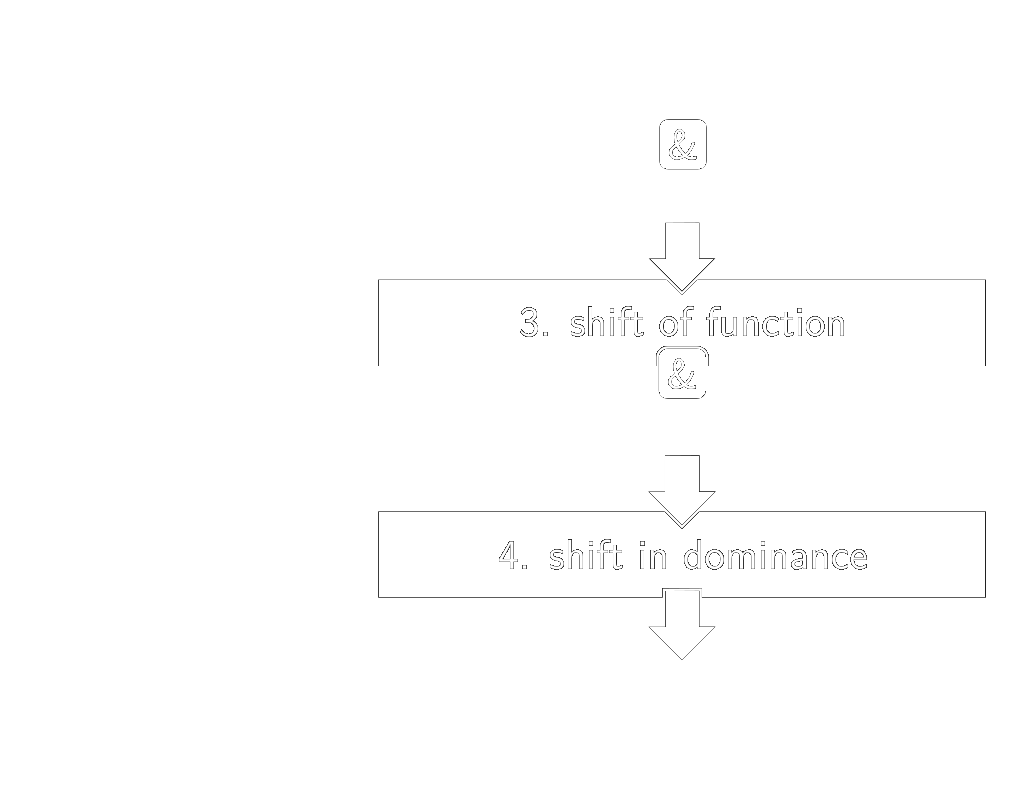
Preconditions: The first logical step is the precondition itself, which is in our case the patriarchal-hierarchical society, in its specific form as capitalism. In that society — like it is in any more or less stable society — its members are steered toward practices that secure their existence, while the execution of those practices reproduces and reinforces the structures of the dominant society. The kind of practice that maintains and renews the existing order is called the elementary form of acting. If the society itself is completely stable, there couldn’t be any change; therefore the second precondition for a transformation are contradictions of development. Such contradictions can be financial crisis, a growing inequality between the rich and the poor or the planetary limits, while the economy has to grow continually.
Development phase: Seed forms running parallel and in tension with the elementary form. They exist in the niches of a society and carry within themselves the potential for a different kind of sociality. To grow into a new society, the seed form has to stabilize the existing society without losing its own specific characteristics (double functionality). In our case, this shift of function (step 3) should make the capitalistic system depend on modes of the caring society, that include practices of commoning. The dominance shift (step 4), finally, is the process of a selective shift in the significance of the new social form relative to the old one. Practices that maintain and renew capitalism are pushed back, and the seed form that once propped up the system becomes the new elementary form: members of society are now predominantly steered towards practices of the caring society to secure their existence. After this dominance shift, a process of social restructuring (step 5) begins, aligned with the new elementary form.
Seed-form theory lets us imagine a kind of radical social change in which new relations are not decreed from above but can be experienced for members of society step by step and ultimately prove functional for their lives. But before going ahead, the two steps of qualitative change deserve particular attention here: the shift of function with its double functionality, and the shift of dominance:
The shift of function is particularly interesting, because unpaid and self-organized activities are meant to support capitalism and make it dependent on them. This is, in fact, not new: unpaid labour, performed especially by women, has been a necessary pillar of the capitalist mode of production since its beginnings (cf. e.g. Federici, EN-Caliban, p. 115). In terms of the shift of function, capitalism must therefore not only be supported by such private unpaid labor (that very framing is already a capitalist perspective). It must help keeping the working class able to labour with even more unpaid work outside the private household and within spheres that are, right now, in the responsibility of the state or can hardly be monetized. Such a development seems hardly progressive. Being progressive would also not be a set goal, because the development would be a necessity of the time. If it were actually set as a goal, it would be progressive only if taking on additional care responsibility by the working class were accompanied by, for example, a transfer of resources that improve care conditions into democratic, self-managed control. Entering into such a negotiation with the state, however, requires a high degree of organization.
Before a shift of dominance can occur, it must make more subjective sense for a large part of a population to make their living by contributing to structures of care than by entering capitalist labor relations. This also means that a large part of the capitalist sphere, including production and distribution, can function efficiently through care structures. Building this up is not even the greatest challenge: even if the majority pushes for a new form of sociality, this changes nothing about the existing relations of ownership and, with them, of power. If a high degree of organization was already needed in the shift of function to enter into negotiation with the state, it is indispensable here to shake private property, the pillar of bourgeois society.
Caretaker Tech will be helpful for expanding more complex structures of care beyond the private sphere and making them efficient. Through Caretaker Tech as part of care structures, capitalist crises will be absorbed and turned into emancipatory domains. With the help of Caretaker Tech, the desire for a different society will ultimately be strengthened. Yet Caretaker Tech can do as little to attack the relations of ownership themselves as it can to support the political organizing that would advance such a democratization. It will be an economic tool of an economic structure that today exists only on a small scale, but that can bring forth the best of all possible worlds.
On Caretaker Tech#
To get closer to the idea behind Caretaker Tech, we will begin with an imagined scene. While such a scene may convey a sense of the vision, it comes with a drawback: the vision of Caretaker Tech may become narrowed to the specific cultural setting in which the scene takes place. Since this cannot be avoided, you, as a reader, are challenged to stay open and think beyond this setting. Along with this conception comes the idea of Caretaker Tech’s implementation as an open economic infrastructure — this will be explained later. Finally, to close this introduction, Caretaker Tech will be defined and the essays written in preparation for the conception will be presented.
Imagination#
Imagine a bonfire. Imagine logs burning on thin branches that have already turned black, with smoke still rising from some of them. The logs glow in never-repeating patterns, sending sparks into the night and making your cheeks glow. Imagine the fire in a hole in the cracked asphalt of a community space’s backyard. It is already late, and it has grown quiet, but you can still feel the energy of a crowd dancing and sweating, of new friendships made and old ones deepened, of a shy glance and a silent touch that has become a new couple, sitting in a dark corner, watching the stars. A musician is searching the stage for something, and you watch two people carry a pole of stage lights back into the building. It is a calm night, and you feel relieved.
Remember how you got there. You were unemployed; you felt alone. One day, your brother-in-law installed a set of apps on your phone to keep you busy. You watched him do it, not sure what to make of it, confused by all those background services and settings. Remember how he told you that one day everything would be easy, but that it would take time; a group was working on it. One of the apps is for sharing resources, he said. When you have the time, you should make an entry for every tool you’d lend to someone, and you can use the app to search for tools you need. He opened another app. That one was for communicating your needs — it could really be anything, he said — and for contributing to cooperative efforts to meet the needs of others. You looked at the interface and it reminded you of a dating app, with tasks instead of people. Then he asked you — without looking up from the screen, as if it were a completely ordinary question — what change you want to see in the world and whom you care for.
Since then, you have known you care about more than you thought. You look across the bonfire to a woman in her forties with a furrowed face, leaning against a wall, smoking, always smoking, and chattering away, as she always does. When you met her on one of your first contributions, you were never quite sure whether she was talking to you or to herself. The contribution was marked as slightly relevant to you personally, since you had stated in your profile that you want to help people who are themselves helping others. It was just a private move for some guy who does a lot of cooking and childcare on workshop days. Transportation tasks like this are often requested, but most of the time they belong to larger economic processes, since there are always resources that need to be somewhere other than where they are right now. Some contributions you have made for private individuals, and some for community and social aid organizations. At the beginning, you checked the plan behind every open task carefully to make sure it had no commercial purpose, but after a few months you came to trust that none of them did. Someone explained to you that commercial actors exploiting volunteers were once a problem, but a few rough court cases scared them off. On many contributions, mainly when handiwork was involved, you met the woman with the furrowed face. Watching her on this particular night, you get the feeling that her well-being is bound up with your own.
Watch the people tidying up the space. Stay where you are; don’t join in — you’ve done enough. There’s one woman collecting the used dishes. She’s listening to someone, laughing with her whole heart. You saw her for the first time this evening, and you’ll never see her again. She’s a researcher who has traveled the world, looking for patterns of behavior in that strange place that now feels like home to you. Remember her amused look when you showed her the timeline in your app: requests to share things you own, collective decisions about adjusting the rules for shared goods, and endless open contribution requests — sorted by how much they matter to the people you care about, the causes you support, and their current relevance to the larger economic processes. Her irritation only grew as she watched that little ritual that repeats whenever a contributor leaves: you show them a QR code, and they show you theirs. Since it is awkward for everyone, it is often accompanied by some kind of joke. Once it is scanned, you told the researcher, each person confirms that the other was actually here for the contribution — and most of the time you give the other person your trust as well. The digital world is only part of what happens here, you tried to make her understand. You told her about a phrase you often hear, “digital times two” — meaning the digital sphere is limited, and you always have to think of those who don’t use these tools. Some say these apps are exactly what they look like: simple tools that help you connect with the neighborhood and support one another from time to time. Others say the apps help create a non-digital sphere, independent of the digital one, that will become the foundation of a post-capitalist society. You shrug, since you don’t really have an opinion on these debates. But since you started using these apps, you feel more connected to life than you have in a long time. For her part, she tells you stories about projects she has visited, her eyes shining as she describes Cecosesola in Venezuela: a commons project involving thousands of people that even runs a hospital. Her stories come to an end when someone asks her to dance, and she jumps up with a broad smile spreading across her face. Now you watch her fade into the dark, and a song drifts back into your mind — a song about those who have traveled the lands of their own soul, who have lived, loved, laughed, and suffered, and in doing so became whole.
Imagine selecting some wood for the bonfire and arranging it over the flames. Be careful not to smother them. You are now no longer alone at the bonfire on that starry night. With deep brown eyes and a shaggy goatee, he is staring into the flames beside you. A good-hearted fellow, carrying the weight of the world on his shoulders. He is one of those who develop and maintain some of the apps you now use every day. He knows what you have done to make this evening possible, and he kindly asks you to tell him about the process from the very beginning. So you tell him how the autumn festival of the community space was approaching and you volunteered to organize the building of the state; something you have never done before. For the whole organization, the apps came in handy. As your brother-in-law once told you, you can request anything, but you knew from experience that, to stand a chance of motivating volunteers, you needed more people supporting your plan. So you campaigned for it everywhere you contributed yourself. Another thing you learned: the more specific your request, the more specific the resources and processes needed to satisfy it — and therefore the smaller the chance that it actually happens. Because of that, you chose three different stage models from an open-source database and proposed building all three at once. From then on, it was no longer in your hands alone. You wished you could be more relaxed about it, but at least once an hour you checked your phone to see whether someone new had committed to one of the processes or shared a resource needed for the project. After two weeks, for all necessary steps of one plan someone was found, but some resources were still not available. Therefore, you had to scrape together some money to buy them — especially stage lights and metal post spikes — but that money could easily be raised again at the autumn festival. When a date for the building was found, everything happened within sixteen hours. You were there, helping wherever you could, since those clear commitments of specific people to specific tasks usually blur on such shared occasions. You had never met most of the contributors before, but at least the woman with the furrowed face was there — as you like to work with her, you have sent here an invitation link. That day, she never stopped grumbling about the material she had to work with — the wooden boards someone brought were in fact rather warped and looked as though they had sat for years unprotected in the rain. This is what you tell the man with the shaggy goatee, and he listens, nodding from time to time. After some inquiries on his part, you both fall silent. “I wonder what a solar-powered bonfire would look like,” he says after a while and scratches the back of his head.
You decide not to keep the fire going, since everyone has gone now. You stare at the embers and remember the appointment you have at the employment office next week. You haven’t written many applications over the past few months, and you don’t intend to write any more in the future. It seems a little odd, but when you think back to your old working life, the first thing that comes to mind is the lunch breaks: those dull conversations between people who see each other every day, not by choice, in a place where they would rather not be. How could you go back to that? And yet, what are you supposed to do, when you can’t live on meaning alone? Someone told you about a city in the south. It was once known for its high unemployment and for the local government’s failure to provide the care structures its population needed. All that changed when people started to organize themselves. At first, they formed voluntary social aid organizations and tried to manage everything through weekly meetings. But then they discovered some of the tools you’re using today. Over there, they didn’t use them to organize community events, but to organize the very structures that kept their world from falling apart. Once the government realized that even the few remaining companies depended on these structures, it offered the activists free use of the houses in an abandoned neighborhood, as long as they didn’t stop what they were doing. Through the mindset of those people living there, these neighborhoods grew into wild and magical places. You searched for a website or any kind of social media presence, but couldn’t find any. Can you trust the one who told you all those stories? When she told you about it, you couldn’t see any lie in her eyes — but can you be sure? You only have one life, they say, so what’s stopping you from finding out?
Implementation#
From the second chapter on, most sections open with a list of functions that are then explored in the text that follows. Many of these functions build upon one another. For example, one function could allow users to create a digital representation of a resource they own, while another could attach sharing rules to that resource — the latter function depends on the data created by the first. Caretaker Tech is the vision that anyone can make use of all these functions and that all of them interact with the same shared data.
In the imagined scene above, several apps were mentioned as well as some background services. There’s a reason for that: implementing all these functions in a single software platform is a very bad idea (see the story of Valueflows for reference). The aim is instead to implement Caretaker Tech as an open infrastructure of interconnected apps with shared (linked) data. Imagine the two functions referenced in the last paragraph implemented as two different applications on your phone: you use the first to maintain a collection of everything you own and to search for things in your vicinity that you are allowed to use under certain conditions. The second app is primarily about rules. You use it to define who is allowed to use your things, and it includes additional functions such as proposing changes to the rules on shared resources or granting access to them. Both applications depend on each other’s data in some way, so they need to exchange information with one another. Protocols are a key part of making that happen. But since different apps may use different protocols, there may be infrastructures with the same goal sitting side by side, completely unable to exchange information. This will hardly be a problem in the near future, but it is important to understand it can always happen within such an open approach.
The open approach with independently developed apps is considerably more complicated than building a closed platform containing all the functions. But the open approach has some important advantages. First, the applications can have a limited scope within which their quality can grow. Second, applications for similar use cases can coexist in a healthy way: if you don’t like the app for handling rules, there may be another one to choose. Third, since users should be able to switch applications without losing their data, ways for them to stay in control of their data have to be built in from the very beginning. Fourth, and finally, aiming at real social transformation while depending on a single huge project would be insane.
Definition#
Depending on the context, the term Caretaker Tech is used in different ways. When it is necessary to analyze existing digital components, the term is used differently for applications and for the components that make them interoperable; the two are defined separately below.
An application counts as Caretaker Tech if it meets two conditions:
Providing functions for an economy beyond market and state: The application itself — or a standalone part of it — provides functions that support an economy based on sharing and voluntary cooperation. Such functions are listed in this text, but the list isn’t meant to be complete.
Aiming for integrability: The application itself — or a standalone part of it — is, or is prepared to be, integrated into an infrastructure with other applications of the same kind, so that users can act within economic structures that go beyond what the app itself offers.
Applications can be built to be Caretaker Tech. Digital components that provide interoperability become Caretaker Tech by being used by such applications:
- Providing interoperability: Any non-application digital component — such as a protocol, an ontology, or a background service — is Caretaker Tech when it is commonly used by corresponding applications to enable interoperability.
This conception is not about classifying individual applications or defining how they interoperate: it is about the economic infrastructure beyond market and state that will emerge through the use of those applications. In this conception — and in any text that looks at Caretaker Tech from a higher level — the term is used more broadly:
- If it is unnecessary to distinguish between its constituent components, the infrastructure itself is called Caretaker Tech. Therefore, when someone “interacts with Caretaker Tech” in general, they are using some application to access the infrastructure; the underlying digital components need not be specified further.
Preparation and Process of Adjustment#
Most of these functions stem from the three essays written in preparation for this conception: The Expansion Drive of Modern Commons (2018), The Timeless Way of Re-Production (2019), and Ostrom for Beginners & Sharing for the Advanced (2024).2 Each essay engaged with one book by another author: Make Capitalism History by Stefan Meretz and Simon Sutterlütti [-@sutterluetti23], The Timeless Way of Building by Christopher Alexander [-@alexander79], and Understanding Institutional Diversity by Elinor Ostrom [-@Ostrom:2005]. As the author of this conception, I would like to thank all of them for helping me understand a society different from the present one. I also want to give credit to Silke Helfrich: you were the heart of our movement, and may you never be forgotten.
The list of functions in this conception is neither complete nor fixed. It is a first attempt to define which functions may support a way of life beyond market and state. This text is published under a Creative Commons license to encourage you, as a reader, to get involved in shaping Caretaker Tech. You can do so by proposing adjustments to the text by email or through the repository.3 If those proposals are rejected, the Creative Commons license grants you the right to adjust the text as you like and republish your own version under another title.
Structural Formula of Commoning#
To grasp a digital sphere that can support with the challenges of commoning, the digital sphere itself must be conceived in structural terms. The structure of commoning is here seen as built by persons or groups intending something: they become aware of an economic problem of some kind and want to act upon it. Many of the various ways of dealing with such an intent — simply satisfying it themselves is one of them — will be beyond the scope of Caretaker Tech. The intent will enter the Caretaker Tech structures only when someone proposes its satisfaction in a way readable by Caretaker Tech. The structures of Caretaker Tech are built around such intents.
There are various types of intents that can be published, but for now we will limit them to three: the intent “to satisfy a need”, the intent “to cover a required resource”, and the intent “to bring a resource out of a problematic condition”.4
$$\begin{rcases} \text{Unsatisfied} \\ \text{Need } (N-) \\[2mm] \text{Resource} \\ \text{Requirement } (R-) \\[2mm] \text{Problematic Resource} \\ \text{Condition } (C-) \\[2mm] \dots \end{rcases} \; - \; \begin{array}{c} \textit{\dots\,Querying} \\ \textit{ \& Planning\,\dots} \end{array} \; - \; \begin{array}{c} \textit{\dots\,Process\dots} \\ \textit{(or act of sharing)} \end{array} \; - \; \begin{cases} \text{Satisfied} \\ \text{Need } (N+) \\[2mm] \text{Coverage of Resource} \\ \text{Requirement } (R+) \\[2mm] \text{Resources in Unproblematic} \\ \text{Condition } (C+) \\[2mm] \dots \end{cases}$$Inside Caretaker Tech, the structure of commoning comprises four phases: publishing the intent, the phase of querying & planning (which might lead to new intents), the process for satisfying the intent, and finally the satisfied intent.
Published Intent: 1. Someone publishes a need that they (or someone else) want to have satisfied (N-). 2. Someone (or something) publishes that a resource is required for a process that aims to satisfy needs, but this resource is not available (R-). 3. Someone (or something) publishes that a resource is in a problematic condition and should be fixed / cleaned / etc. (C-). While intents to satisfy needs are always published by humans, intents to cover resource requirements or to bring resources out of a problematic condition can, under certain conditions, also be published by algorithms.
Querying and Planning: There are multiple ways in which an intent could be satisfied, and each of them depends on the availability of different resources, on the steps that must be taken in advance, and on the commitment of someone to perform these processes or — in the case of resource requirements — to share resources they have access to. In the phase of querying and planning, new intents may be published. If this phase ends successfully, a plan is created indicating what will be done or shared, by whom, and within what time frame. If it does not, the intent will not be satisfied; at least not within Caretaker Tech.
Process (or act of sharing): A process is an act of time and effort: someone who committed to perform the process uses some resources to satisfy the intent. If the intent is a resource requirement, instead of a process there could be an act of sharing as well.
Satisfaction: The process satisfies the corresponding intent. Within our scope, this is either a need that is satisfied (N+), a requirement for a specific resource that is covered (R+), or the defined condition of a resource that has been (re)established (C+).
Because new intents may arise in the phase of Querying & Planning (to cover resource requirements or to bring resources out of problematic conditions), any plan can be imagined as a tree. The process to satisfy the original intent is on the first level. Any process that satisfies a dependency of the first-level process is on the second level. If these processes need something to be done ahead of their performance, there are further processes needed; those would be level three and so on. To perform the process of the original intent (which could be someone’s need), all these other processes must be finished, since they create the necessary inputs for its performance.
A Glimpse Into the Infrastructure#
Caretaker Tech is presented in detail over the course of this text. What follows is a brief overview of the next parts.
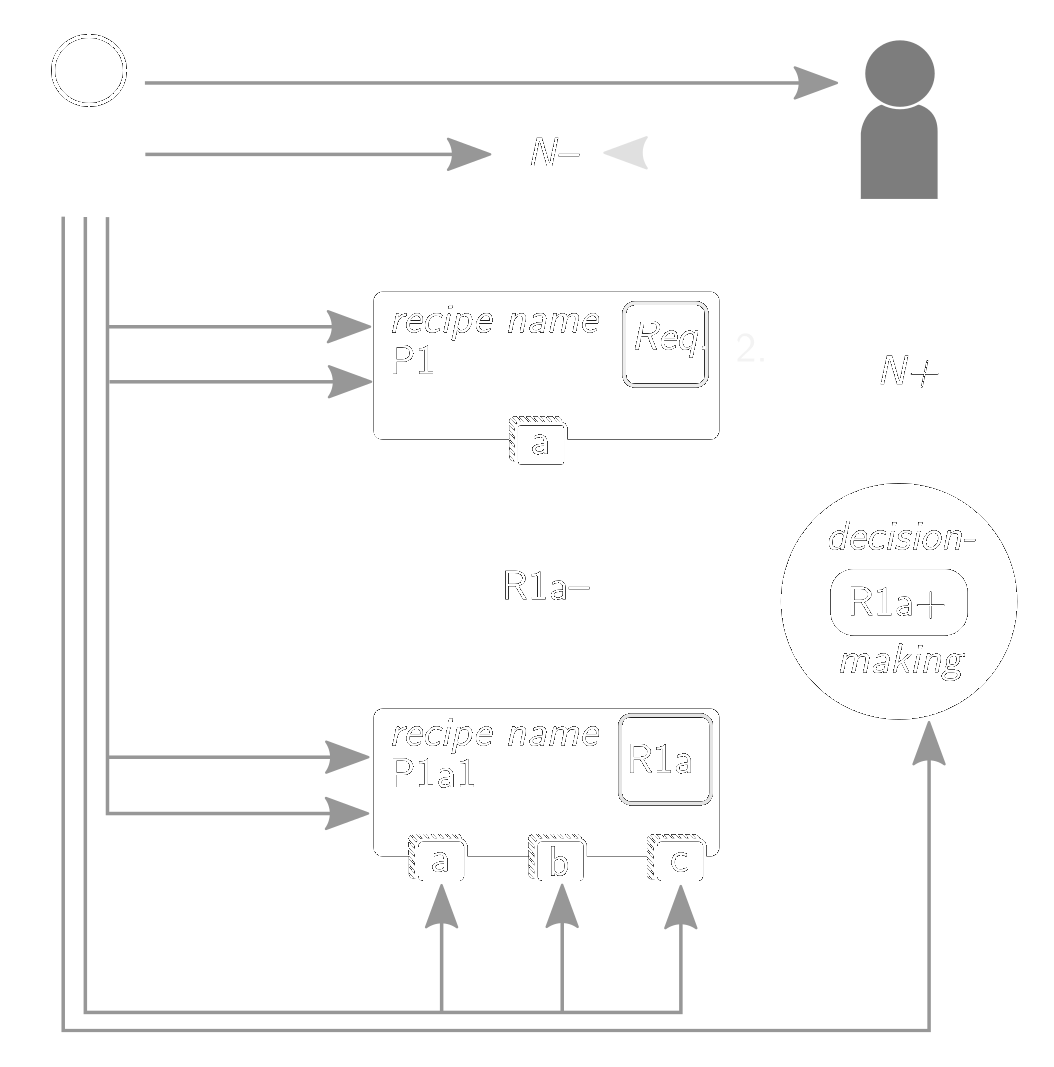
Since Caretaker Tech will support cooperation toward satisfying needs, it will include functions to publish those needs as well as to publish any intent necessary for the satisfaction of a need (N– / R– / C–). Every intent is satisfied (N+ / R+ / C+) through a process — in the graphic, this process is called P1. Process P1 may be specified as a recipe: a form of sharing practical knowledge by specifying a process together with its output (the intent it satisfies and possible side effects) and possible inputs (the resources the process requires). For the performance of process P1, resource a is needed, or, in relation to process P1, resource R1a. Therefore, some process for making resource R1a available is needed before process P1 can be performed. Since there are multiple ways to make resource R1a available, there are multiple scenarios for how the published intent could be satisfied. (Part 2: According to Needs and Abilities)
Process P1a1 is one possibility for making resource R1a available. If someone commits to performing this process, the plan for how the published need will be satisfied can be settled. In many cases, dozens of processes (each depending on the performance of another) are needed to satisfy one or more needs. Since Caretaker Tech will operate beyond market and state, the commitment to perform specific processes can only happen voluntarily. The Distributed Planning Process is a method for carving out efficient plans even in complex scenarios by proposing pre-selected recipes to agents in the need’s vicinity, targeting the least total effort in these plans. (Part 3: The Planning Process)
The functionality of the Distributed Planning Process depends on published knowledge in the form of recipes and on published information about which resources are available to which persons, and under which circumstances. Since we are dealing with resources that may not be the private property of individual persons, it is neither straightforward for all the people related to a resource to agree on rules for sharing, nor straightforward to make this information machine-readable. To support this, various methods are necessary (Part 4: Handling the Commons).
Within the frame of Caretaker Tech, there can be neither payment for the performance of a process nor any other gift or privilege of any kind. Beyond idealism, what might be one’s individual interest in contributing? The answer proposed in this concept is called consideration. Participants can consider various aspects of life — including effort undertaken on behalf of others — and if a process targets the need of a person to whom such an aspect applies, that process is marked as personally relevant for the considering participant. Gaining an advantage from contributing to the economy therefore depends on whether other participants regard that participation as important. Since life circumstances such as being unemployed or being a single parent, and social relationships such as being related or befriended, can also be taken into account, this helps shape the cooperative structure toward the participants’ interests and morals. (Part 5: I-in-Relation)
Used Vocabularies (Valueflows & ODRL)#
There is one major problem in building an open economic infrastructure of any kind: the differing use of terms and concepts to describe the countless entities of the economic sphere, their properties, and their relations. Imagine independently developed apps as people speaking different languages, where a word in one language may or may not carry exactly the same meaning as its translated counterpart in another. It takes a great deal of time and effort before two apps of this kind can seamlessly exchange information with one another, and when a third app comes along, speaking a third language with its own concepts, everything becomes difficult again.
Vocabularies come in handy here, since they define the terms, their properties, and their relationships. All projects that conform to them can communicate with one another (at both the human and the machine level) from the very beginning. Committing to the use of a vocabulary may restrict a project’s freedom to choose its own words and define their meanings, and it means some extra effort in learning and understanding the common vocabulary — but if we are doing this not as a hobby but as a real attempt to participate in overcoming capitalism, conformity becomes a duty.
As Caretaker Tech doesn’t exist yet, neither the used vocabulary nor the used protocol (the technical side of communication between applications) can be known: the ones building it will use the standards, that are both well suited for the task and widespread in the moment of its appearance. But right now, one vocabulary is highly recommended for any application that is to be integrated into an open economic infrastructure: its name is Valueflows, and its story carries some wisdom.
All of the functions described in this conception could, in principle, be built into one huge block of code (a monolith, as they say). That this is not a particularly good idea was demonstrated by Lynn Foster and Bob Haugen, who together form Mikorizal. Mikorizal is a project that puts itself in the background to support other teams working towards a post-capitalist economy. One of their earlier projects was Network Resource Planning (NRP) for Sensorica. The idea behind NRP was in some ways similar to Caretaker Tech: it was an approach to support makerspaces in pooling their resources, planning economic processes on a peer-to-peer level, and logging the contributions of members. But NRP was developed as such a monolith: the software could do a great deal, but it quickly grew unwieldy. Adapting it to different contexts became increasingly difficult, and contributing to its huge codebase became nearly impossible for newcomers [@mikorizal:2021]. The project died in lack of maintenance a few years later, by which time Mikorizal had already moved on and was participating in discussions about how such a monolithic block could be avoided. Together with other activists, they sought to figure out how a decentralized infrastructure of Free and Open Source Software could emerge in which functionalities similar to those of NRP would still be possible. Out of these discussions arose the idea of a common vocabulary; as a foundation, they used the Resource–Event–Agent (REA) model by William E. McCarthy, which they had already tested in NRP.5 Ever since, Bob Haugen and Lynn Foster have been working on extending it beyond the private business sector, and this is ultimately what Valueflows is about: “a vocabulary for the distributed economic networks of the next economy, to coordinate the creation, distribution, and exchange of economic resources.” [@valueflows:2026]
To build on this experience, the Valueflows vocabulary will be used within this text; in the glossary, terms from Valueflows are marked and their definitions are adopted. It is not the goal for every technical detail of Valueflows to be understood by reading this conception of Caretaker Tech. The aim is to ease the inherently difficult entry into the vocabulary, while keeping the tone as natural as possible. While not all terms used in this paper have an equivalent in Valueflows, the team will adjust and extend the vocabulary when a new term has proven necessary in at least one project.
Since Valueflows does not cover rules, the ODRL (Open Digital Rights Language) 2.26 vocabulary will be used for this topic. It has a commercial and therefore rather uninteresting history — it is used because there is no better one.
See an introduction to Ostrom in the third Caretaker Tech Essay: Ostrom for Beginners & Sharing for the Advanced. ↩︎
The three essays are freely available under a Creative Commons license (CC BY-NC-SA 4.0) in this repository: codeberg.org/Caretaker-Tech/caretaker-tech__essays. ↩︎
The conceptions repository: https://codeberg.org/Caretaker-Tech/caretaker-tech__conception ↩︎
More examples of economic requests are listed in section Further Kinds of Processes: Updating and Rule-Setting. ↩︎
A lot of resources dealing with REA are listed on the Valueflows website: https://www.valueflo.ws/appendix/rea/ ↩︎
Recommendation of the World Wide Web Consortium (W3C): https://www.w3.org/TR/odrl-model/ ↩︎