
This post was originally written in German for keimform.de
Finally, the debate is back! After Hermann Lueer’s critique of Kapitalismus aufheben, Meretz’s reply wasn’t long in coming, and the Initiative Demokratische Arbeitszeitverrechnung (Democratic Working-Time Accounting) has added another round. The question is whether or not it’s a good idea to establish working time as the general unit of account of a post-capitalist society. This piece doesn’t aim to wade into the fray. Rather, as a side note, if you will, it shows how working time can be taken into consideration in societal mediation in a way that fits the commons, provided very specific conditions are met.
Principle and Prerequisites#
The method presented below was developed in the now-defunct software-based transformation project Global Commoning System, which is reloaded under the title Caretaker Tech. The Global Commoning System grew out of a solidarity-based, critical engagement with Kapitalismus aufheben and set out to realize a particular kind of transpersonal mediation layer: one that overcomes the limitations of today’s commons so that even complex re/production chains can be handled efficiently, without abandoning the conditions of voluntariness and open disposal. We only discovered the method of consideration, or the tendential individual advantage, in the third year of the project, after very long discussions about how people in this transpersonal space can be motivated to contribute in the first place.
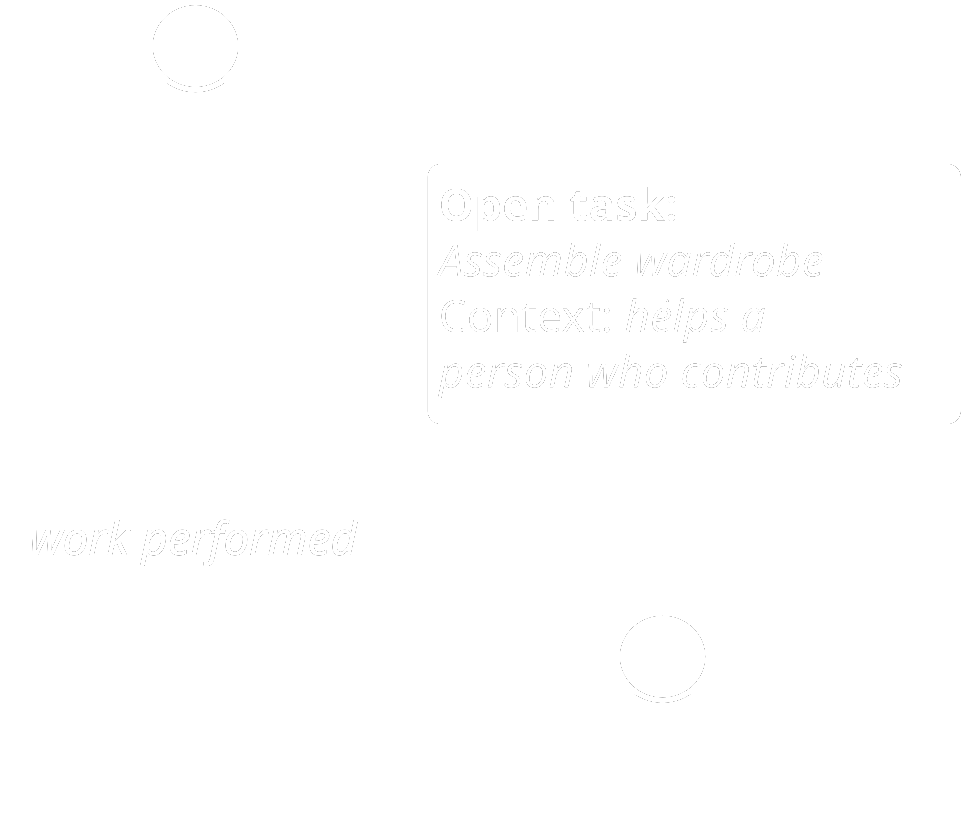
The basic idea is simple: in my ordinary life I can take it into account when someone has done something for others. Take the much-debated example of the shared household: if Alice keeps cleaning the kitchen and Bob smokes weed all day, and both ask me to help them with something (“assembling the IKEA wardrobe”), then I can factor the working time Alice has put in into my decision, turn Bob down, and pull out the Allen key for Alice. This way of thinking is not some abstract academic construct but everyday practice in modes of action beyond market and state logic.
Under the following conditions, this way of acting can now be integrated into more complex re/production processes:
- People communicate their needs in machine-readable form. Whether these needs are only accessible within a limited circle (friends, verified network members) or completely open is irrelevant.
- It is known which (interdependent) activities can satisfy these needs, and such activities are proposed to others as open tasks via information technology. Insofar as it suits the person communicating the need, there can again be several different scenarios of need satisfaction in parallel.
- The average working times of the activities required to satisfy the needs must have been defined. Recipes are particularly handy for this: viewable process descriptions with precisely defined inputs and outputs. In principle, any activity that can’t be (or hasn’t been) defined in isolation can be included too, as long as there is an institution that verifies the hours worked in a machine-readable way.
If the working time performed is then recorded in a personal account, information about a person’s contributions can be attached to open tasks that benefit them. That means that, without having to understand the context of the task, others can see whether carrying it out helps someone who has done something for others themselves, or who has done more for others than has been done for them. This works without problems even in very complex re/production processes, i.e. when many successive activities are necessary. It works just as well when the activities serve several people (cleaning shared spaces, building a machine, assembly-line work, etc.); here, the task could carry the information that it helps so-and-so many people who have (this month, say) performed on average so-and-so many hours more work for others than has been performed for them. After all, this knowledge can guide action. That is, on the basis of this information, someone may take on an activity they would not otherwise have taken on. In that case, the living conditions of contributors improve relative to those of non-contributors. It’s important to keep in mind that one’s own work contribution for others only brings a tendential individual advantage, because this advantage depends on the contribution being action-guiding for other contributors.
We can set aside the information-technology challenges this method raises here: it’s a discussion among theorists, after all. Besides, it’s about to get much worse.
Work Contribution and Other Aspects of Life#
In the previous scenario, Alice’s request for help was given consideration because of her work contribution, unlike the request of the perpetually stoned Bob. But suppose — plot twist! — Bob doesn’t smoke marijuana all day because he doesn’t care about anything, but because it eases the pain caused by a chronic nerve disease that torments him from morning till night. Under this assumption, ask again: who should be helped? The high-performing Alice or the pain patient Bob? It’s no longer so simple.
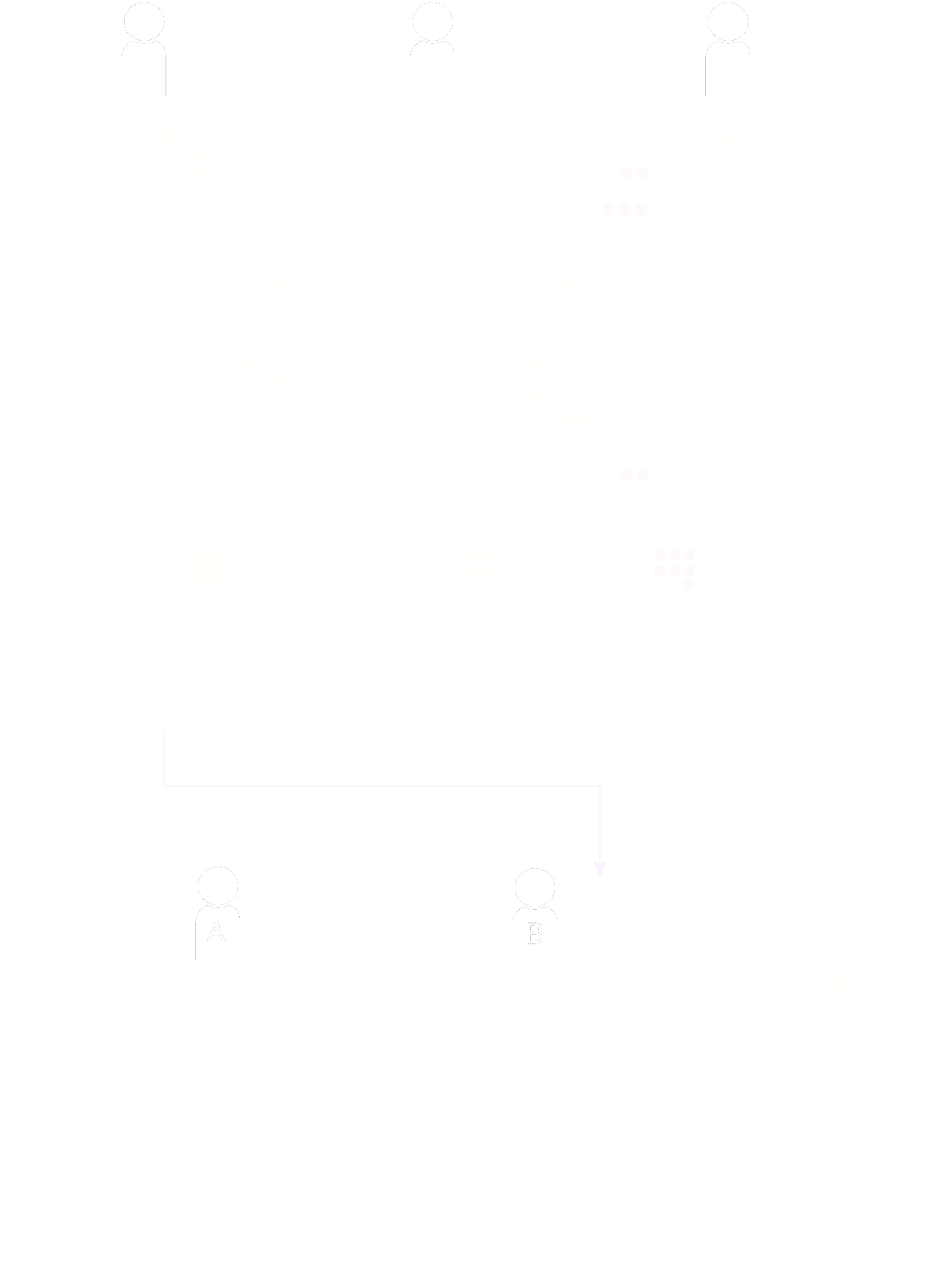
Work contribution is one of many aspects of life that we can in principle draw on when we do unpaid work for others. Another is being related to, or friends with, the people seeking support. Besides chronic illness, we can also include other circumstances such as (relative) poverty or being a single parent. Insofar as these aspects of life can be communicated and, where necessary, verified (ideally while protecting the privacy of those concerned), information about them can be attached to open tasks that point toward satisfying these people’s needs. After all, participants need the possibility to state what is personally important to them: being there for people who do a lot for others (in general or in specific ways); being there for people affected by poverty or illness; being there for people they are related to or friends with, etc. etc. The interplay of such statements with the information about the life aspects of those communicating needs yields a personal relevance of open tasks that is entirely individual, i.e. differs from person to person. Assuming the associated information-technology challenges are adequately solved, contributors can then trust that the re/production process moves in the direction of their personal values if they only take on tasks that have been marked as personally relevant to them.
Drawing: Extensive Example of the Consideration Methode
“But,” every self-respecting working-time advocate must now exclaim, “this is once again the same annoying conflation of working time with whatever!” And you’re right! Taking work contribution into consideration is the essential motivation to get involved, and if work contribution is considered little or not at all, less will tend to be done, and the poor and the sick won’t be helped either. Within voluntary contexts, taking work contribution into consideration is what both builds and sustains the respective sociality. The designers of corresponding software tools would therefore do well to suggest such consideration of work contribution, and a culture that holds it in high regard would help, too. Whether the contributing person follows this digital or cultural nudge is solely at their discretion. We can only hope.
Concluding Remarks#
In fact, more complex production chains in commons relations face quite different challenges than motivation alone. For such chains to work according to a plan, the fundamentally open disposal (a basic property of commons) must be restricted at least to the extent that all resources arising during the execution of the plan are subordinated to the plan’s purpose, or that the producers at least get to decide what the product they made is used for: namely, the next production step. If open disposal can’t be restricted in this way, then in principle anyone can barge in after any production step and claim a new use for the resource. For the socialist planner within us, that’s terrible. But such barging in also means — insofar as it prevails and is recognized as justified in context — that there seem to be more necessary uses for this product that weren’t recognized in the digital space alone. The “barging in” is then less a disruptive factor than the needs-oriented society itself coming into its own. For the contributing person, however, who originally wanted to support very specific people, this means the following: better do everything twice, then maybe it’ll work out.
Even setting aside the dependence on the digital and the patchiness of individual value-setting, such a commons-style consideration of working time cannot be society-sustaining. The slap in the face from Silke van Dyk and Tine Haubner’s Community-Kapitalismus still stings, and we have to ask who, in the end, will quite voluntarily care for the elderly Nazi in need of care. As long as we don’t want to shift this responsibility onto the “new human of communism”, hardly anyone will do it. On the way to a better world, it therefore behooves us commoners to march along arm in arm under the red flag of socialism, without constantly getting on everyone’s nerves with our lofty ideals of voluntariness and open disposal. Whether this socialism then plans with money or working time is not all that important at first. But working time is better.